


If you’ve been anywhere near a Power Platform study group this month, you’ve probably seen the letters “AB-400” floating around and wondered whether your PL-400 plans just became worthless. They didn’t. Microsoft is retiring the PL-400: Microsoft Power Platform Developer exam and replacing it with a new one, AB-400, and the two exams lead to the exact same credential. But the scope underneath that shared name has shifted quite a bit — enough that it’s worth twenty minutes of your time before you decide what to study next.
I’ll walk through exactly what’s changing, why Microsoft says it’s doing this, the dates that actually matter, and — more usefully — what I’d personally do depending on where you are in your own prep right now.
An Exam Change, Not a Certification Change
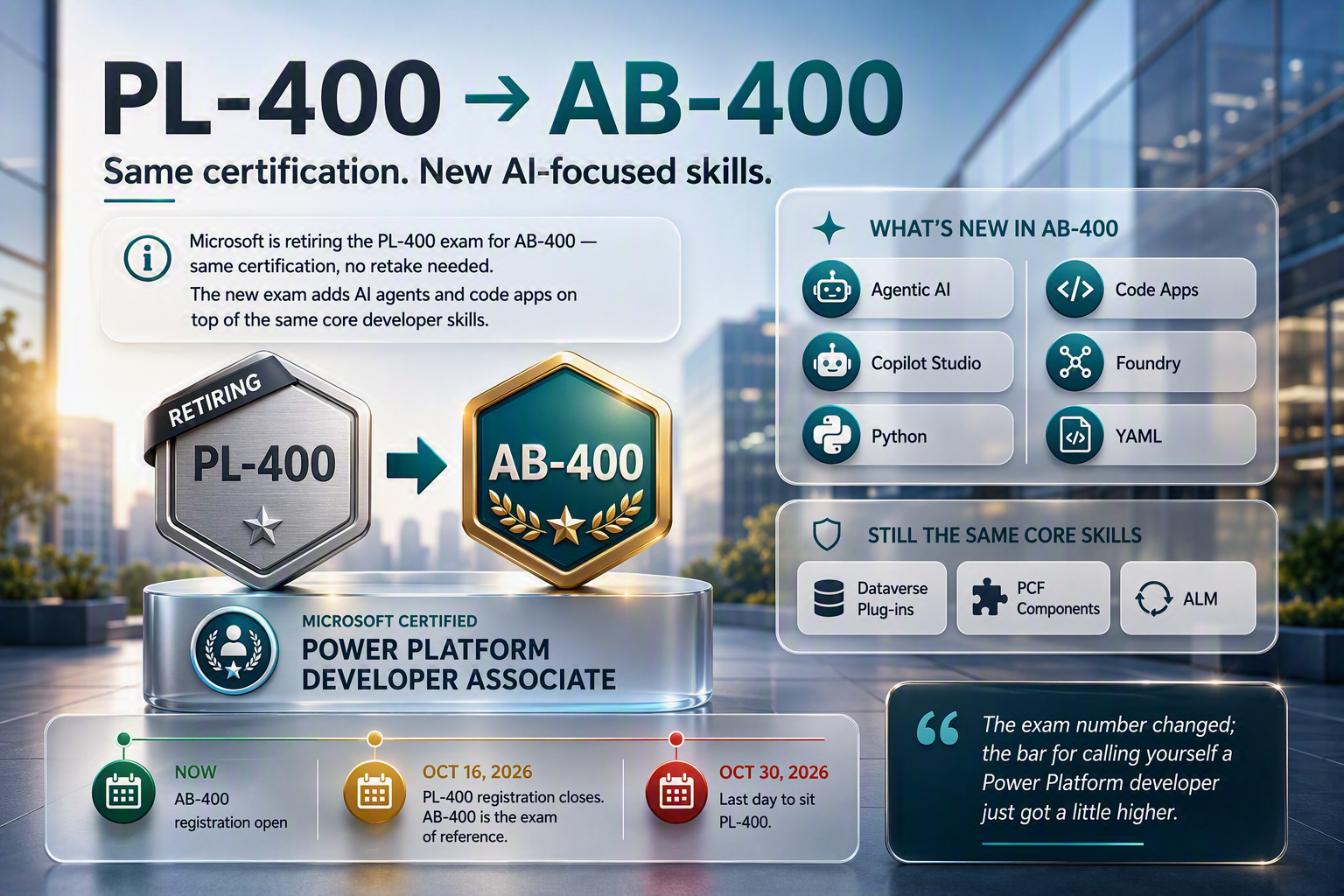
Here’s the headline, stated plainly because it’s the part people panic about first: this is a swap of the exam, not the certification. Both PL-400 and its replacement, AB-400, are listed on Microsoft Learn as the required exam for the same single credential — Microsoft Certified: Power Platform Developer Associate. Pass either one, and you walk away with that same title on your Learn profile.
If you already hold this certification, Microsoft’s own guidance is unambiguous: no action required. You keep the credential you earned, it renews the way it always has — a free annual assessment on Microsoft Learn — and nobody is asking you to sit anything again. I’ve seen this kind of transition spook people who assume “new exam number” secretly means “old certification revoked,” and that’s just not what’s happening here.
Why Microsoft Is Doing This
Microsoft’s own announcement frames the reason in one sentence: modern Power Platform development “increasingly includes AI integrations, custom code experiences, intelligent agents, and advanced extensibility capabilities,” and the exam is being refreshed to match how developers actually build things today rather than the scope PL-400 was designed around originally. That’s a fair read of where the platform has gone — a developer exam that never mentioned agents or code apps would look pretty dated by 2026.
The Dates That Actually Matter
Three dates decide which exam applies to you, and they’re worth writing down rather than trusting to memory:
- Right now: AB-400 registration is already open — you don’t have to wait for it.
- October 16, 2026: PL-400 registration closes for good. From that date on, registration is exclusively for AB-400.
- October 30, 2026: the last possible day to actually sit PL-400 — and only if you registered on or before October 16.
One more thing worth flagging: as of publication, AB-400 has no announced retirement date of its own. Treat the dates above as the ones that matter for right now, and check Microsoft Learn directly before acting on this if you’re reading this well after October 2026 — an article can’t update itself when a deadline quietly moves.
What’s Genuinely New on AB-400
Comparing Microsoft’s own published change log for the two exams, a real chunk of AB-400’s content didn’t exist on PL-400 in any form. The additions cluster around three ideas: building interfaces with less traditional code, wiring up AI agents, and using AI tools as part of the job itself.
Power Apps code apps get their own dedicated coverage — both building them (hooking up Power Platform connections, tables in Dataverse — Microsoft’s built-in business database for the platform — cloud flows, and Copilot Studio agents) and, separately, deploying and monitoring them in production. If “code apps” is new to you: think of it as a way to build an app largely through pro-code, in a modern web framework, while still plugging into the same connectors and data your low-code apps already use.
Then there’s the agent side. AB-400 now covers MCP (Model Context Protocol) servers for Power Platform solutions — MCP is an emerging open standard that lets an AI agent discover and call a system’s capabilities in a structured way, rather than being hand-wired to one API at a time. On top of that, the exam expects you to know how to connect custom agents to Copilot Studio agents (Copilot Studio is Microsoft’s low-code tool for building conversational AI agents), integrate agents with Dataverse data, and build agents in Microsoft Foundry — Microsoft’s platform for developing and deploying AI models and agents — that talk to Power Platform.
Even the “soft” expectations shifted: the exam’s own audience profile now explicitly calls for “applied knowledge of AI-assisted tools and agents to enhance solution development and troubleshooting,” alongside comfort with modern IDEs like Visual Studio Code. And the language list grew — Python and YAML join the existing JavaScript, TypeScript, C#, and Power Fx (the Excel-like formula language used throughout Power Apps) expectations.
What Stays Exactly the Same
This is the part I think gets lost in the noise: the developer fundamentals that made PL-400 a genuinely hard exam are still there, mostly untouched. Dataverse plug-ins — the event pipeline, custom APIs, the Plug-in Registration Tool — carry straight over. So does the Power Apps Component Framework (PCF, the mechanism for building custom UI controls), platform API operations against the Dataverse Web API, application lifecycle management (ALM — the discipline of moving solutions safely between environments), custom connectors, and Azure Functions for background processing.
None of that got watered down to make room for the AI content — it got reorganized around it. If you’ve already put serious hours into plug-ins or PCF components, that work isn’t wasted; it’s still the backbone of the exam.
Where the Exam’s Weight Actually Shifted
The four skill areas kept their names and their percentage ranges — that part didn’t change on paper. What did change is what’s packed inside two of them, which is worth seeing side by side:
| Skill area | Weight | What grew here |
|---|---|---|
| Build Microsoft Power Platform solutions | 15–20% | Technical-architecture decisions now explicitly include when to use code apps, agents, and MCP. |
| Extend the user experience | 25–30% | Two brand-new subsections: building, then deploying and managing, Power Apps code apps. |
| Extend Microsoft Power Platform | 35–40% | A new subsection on building Microsoft Foundry agents that integrate with Power Platform, plus Copilot Studio workflows added alongside cloud flows. |
| Develop integrations | 10–15% | Held closest to its PL-400 shape — mostly Dataverse event publishing and custom connectors, unchanged in spirit. |
The takeaway isn’t “the exam got harder” or “the exam got easier” — it’s that the same amount of exam real estate now has more AI- and agent-flavored content competing for it. If you were planning to coast through “Extend the user experience” on PCF knowledge alone, that section just got a second half you can’t skip.
So, What Should You Actually Do?
This is the question everyone actually cares about, and the honest answer depends entirely on where you’re starting from.
- Already certified? Nothing. Genuinely nothing. Keep renewing on your normal annual cycle and move on with your day.
- Deep into PL-400 prep and close to exam-ready? Finish it. Register before October 16, 2026, sit it by October 30 at the latest, and you’ll land the identical certification you were already working toward — no reason to throw away months of study for a scope change that mostly adds, rather than replaces.
- Just getting started, or still early in your study plan? Go straight to AB-400. Studying PL-400’s narrower scope now only to relearn the AI and agent material later is wasted effort — AB-400 is also the only path that stays open once October 2026 closes the door on PL-400 entirely.
⚠ One caveat worth checking yourself
If you’re holding PL-400 as a prerequisite toward a higher-level or expert certification, don’t assume this article covers that angle — it doesn’t. Microsoft’s general policy is that a prerequisite certification has to still be active at the moment you complete every requirement for the expert-level credential, and prerequisite rules vary by certification. Go check that specific credential’s own requirements page directly rather than extrapolating from what I’ve written here.
Key Takeaways
- This is an exam swap, not a certification swap — PL-400 and AB-400 both lead to Microsoft Certified: Power Platform Developer Associate, and existing holders don’t need to do anything.
- Mark the dates: AB-400 registration is open now, PL-400 registration closes October 16, 2026, and October 30, 2026 is the last day to sit PL-400 for anyone registered in time.
- What’s new leans heavily AI and agent-shaped: Power Apps code apps, MCP servers, Copilot Studio and Microsoft Foundry agent integration, plus Python and YAML added to the expected languages.
- What stays is the hard part that made PL-400 respected: Dataverse plug-ins, PCF components, ALM, custom connectors, and Azure Functions carry over largely intact.
- Your move depends on your starting point — finish PL-400 if you’re nearly there, start fresh on AB-400 if you’re not, and double-check prerequisite rules separately if another certification depends on this one.
Conclusion
Exam transitions like this one tend to generate more anxiety than they deserve, mostly because the headline (“your exam is being retired!”) lands before the reassuring part (“…and it doesn’t affect your certification”). Once you separate those two facts, the actual decision in front of you is a fairly ordinary one: look at how close you are to PL-400-ready today, check it against two dates in October, and pick accordingly. The developer skills that got you interested in this certification in the first place — Dataverse, plug-ins, real extensibility — aren’t going anywhere. Microsoft just added a few more rooms to the house.
The exam number changed; the bar for calling yourself a Power Platform developer just got a little higher.