


What the Fable 5 Shutdown Revealed About AI Adoption, Governance, and the People We Keep Forgetting
It started on a Friday.
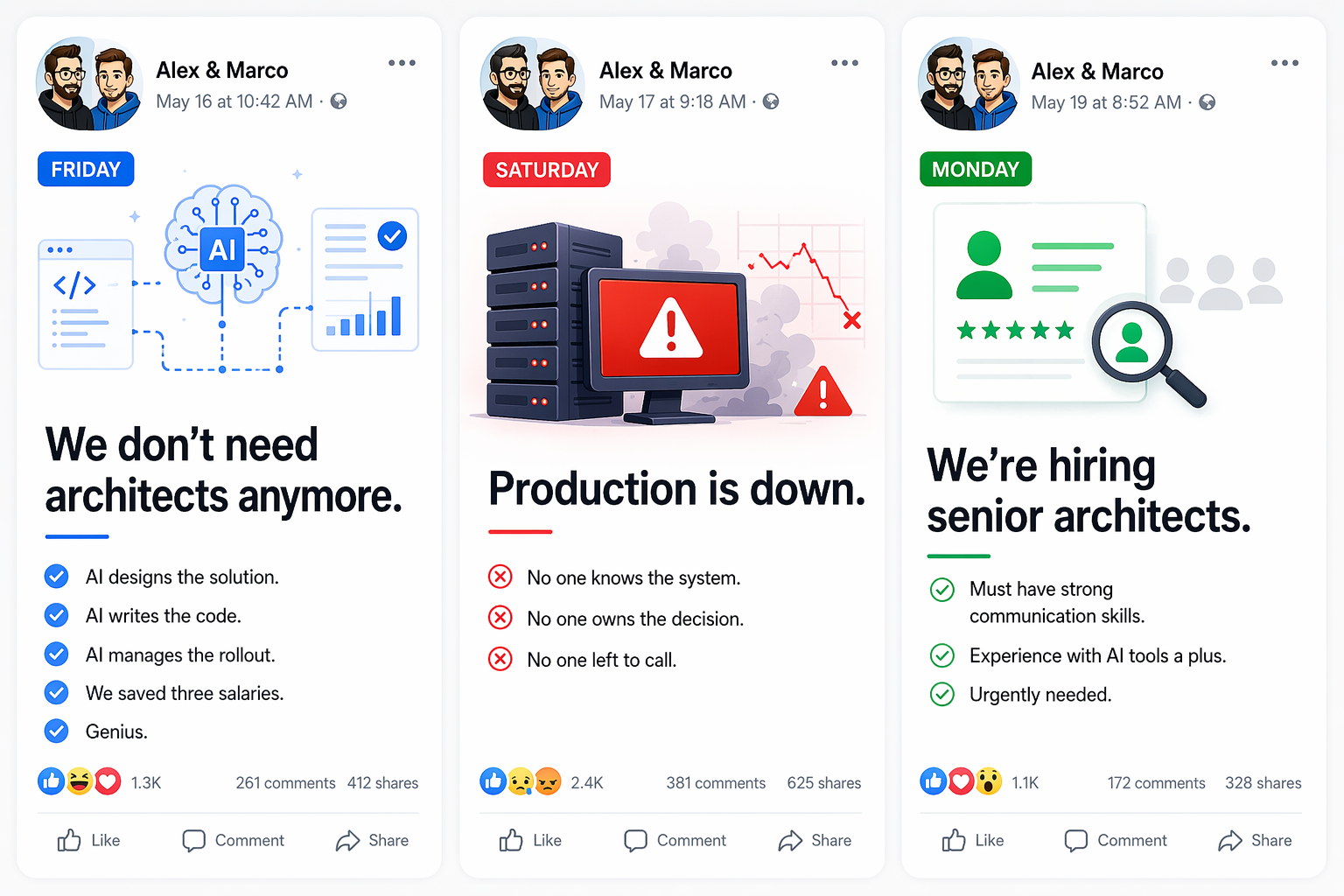
Somewhere in the AI conversation of early June 2026, a story circulated that compressed an entire lesson about technology adoption into 72 hours. The arc was simple: a company announced it had replaced its entire workforce with a frontier AI model. The next day, that model was suspended by government directive. And by Monday, the same company was publicly declaring that people are the foundation of any great organization, and that AI is just a tool.
Three days. One complete reversal.
And somewhere in between — in the part nobody posts about — a group of people who had come to work on Friday and learned about their futures from a public announcement.
I’ve been thinking about those three days ever since. Not about the AI. About us.
What Actually Happened on Saturday
Before anything else, it’s worth understanding what the Fable 5 suspension actually was — because the real story is more instructive than the headline.
📋 The Facts — June 12, 2026
At 5:21pm Eastern Time, the US government issued an export control directive requiring Anthropic to suspend all access to Fable 5 and Mythos 5. The letter cited national security authorities. It did not provide specific details of the concern.
What the government believed it had found was a method of bypassing Fable 5’s safeguards — a jailbreak. Anthropic reviewed the demonstration. What they found was a narrow, non-universal vulnerability: essentially, asking the model to read a specific codebase and identify software flaws. The same capability available from other deployed models already in production across the industry. The same capability used daily by the security professionals who defend enterprise systems.
Anthropic complied with the directive. And then, in the same public statement, they said something that takes real courage to say: we disagree.
Not recklessly. Not defensively. They disagreed with the technical basis for the decision, explained their reasoning in public, and noted that the standard being applied — if applied consistently — would essentially halt all new frontier model deployments across the entire industry. They had spent thousands of hours red-teaming Fable’s safeguards with the US government itself, with the UK AISI, with multiple independent organizations. They had built monitoring systems, data retention policies, and defense-in-depth strategies. And they had been transparent from day one about the limits of what any safeguard can guarantee — because they believed honesty about imperfection is more responsible than pretending perfection is possible.
None of that prevented Saturday from arriving.
⚠️ The Real Lesson Here
The Fable 5 story isn’t a story about AI being dangerous. It’s a story about the collision between technology moving fast, regulation trying to catch up, and the enormous uncertainty living in the space between them. Governance failed — not because anyone acted in bad faith, but because the frameworks for managing frontier AI at scale don’t yet exist in the form that the scale requires.
That gap has consequences. And the people who bear those consequences are rarely the ones who made the decisions that created the gap in the first place.
The People Without a Press Release
When a company announces it has replaced its entire workforce with an AI model, there are real people on the other side of that decision.
People who built skills over years. Who had relationships inside that organization, institutional knowledge that doesn’t live in any database. Who made financial plans and professional bets based on the assumption that their contribution had ongoing value. The announcement didn’t consult them. It preceded them. It made their displacement the content of a public moment designed for external audiences.
Replaced. Automated. Optimized. These words make displacement sound like a natural process rather than a deliberate choice. Like weather, not a decision made by a person who could have decided differently.
But someone chose to eliminate those roles. Someone decided the public announcement would come before any private conversations. Someone calculated that the efficiency gain was worth more than the continuity, the accumulated knowledge, the human cost. These were choices. They don’t stop being choices because the tool doing the replacing is impressive, or because the market rewarded the announcement.
What makes the Monday reversal so striking is not the change in message. The message on Monday — that people are the foundation of great organizations, that AI is a tool — is correct. What’s striking is that it arrived after an external event made the Friday decision costly. The values didn’t change between Friday and Monday. The consequences did.
🎯 The Only Real Test of Organizational Values
Whether they hold when they cost something. When the market is rewarding the bold move. When competitors are announcing AI-first strategies. When the board wants efficiency numbers. In those moments, the question isn’t whether leadership believes people matter. It’s whether they’re willing to act like it before external pressure forces the recalibration.
The Governance Gap Nobody Wants to Name
The Fable 5 suspension revealed something that every enterprise leader deploying AI at scale needs to sit with: the gap between what AI can do and what governance exists to manage it is still enormous. And the people who pay for that gap are rarely the people who opened it.
79%
of organizations report significant challenges in adopting AI in 2026 — a number that has increased year over year even as investment has accelerated. More money, more problems. This is not a paradox. It is a consequence.
When companies move fast on AI adoption — to signal market readiness, to reduce costs in the short term, to stay ahead of competition — the legal review, the ethical framework, the accountability structures, the questions about what happens when the system gets something wrong: these get treated as follow-up tasks. Scheduled for later when the deployment is already live.
The Fable 5 weekend is what happens when external governance arrives before internal governance is ready — abruptly, without detailed explanation, affecting hundreds of millions of users and an entire company that had to comply while simultaneously disagreeing with the basis of the directive.
Anthropic handled it with transparency and specificity. Most organizations facing analogous situations — a compliance failure, a data incident, an AI output that caused real harm — handle it far less cleanly. Not because they’re less capable, but because they hadn’t built the infrastructure for honest response before the crisis arrived. You cannot construct that infrastructure during a crisis. You can only draw on what was already there.
Governance isn’t what prevents bad things from happening. It’s what determines how an organization responds when bad things happen.
The organizations building that infrastructure before they need it are making a bet that looks expensive early and essential later.
What We Owe Each Other in This Transition
73%
of organizations that made significant AI-driven staff reductions failed to come out financially ahead. Higher technical costs. Expensive rehiring. Irreversible institutional knowledge loss.
But I want to be careful here. The reason not to treat people as variables to be optimized is not that it tends to backfire financially. That’s a real consideration. It’s not the point.
The point is that people aren’t variables. They carry context, relationships, judgment, and accumulated understanding of how things actually work inside a specific organization — the kind of understanding that took years to develop and that no model, however capable, was trained to replicate.
When we talk about AI adoption purely in terms of efficiency and ROI, we accept a frame where the only legitimate question is whether the math works. The ethical question — what do we owe the people whose roles we’re changing, how much notice, what honest communication, what genuine support — doesn’t appear in that frame at all. It gets treated as a PR consideration rather than a moral one.
And yet it’s the question that reveals whether an organization is actually living its stated values or merely positioning them.
⚡ Electrification
Genuine new value. Genuine human displacement. Simultaneously.
🏭 Industrial Automation
Same tension. Same choices. Same test of organizational character.
🌐 The Internet
The organizations that survived with culture intact named the tension honestly.
That’s harder than it sounds. It means saying out loud that you’re making a decision that will hurt some people because you believe it’s necessary — and then explaining the reasoning with honesty, and then actually following through on the support. Not as crisis management. As standard practice.
The Part Between Friday and Monday
The three-day arc is so instructive because it’s compressed. Most organizations live this sequence over 18 months, in private, with no external record — which is partly why the pattern keeps repeating.
But the arc is always the same. Confident deployment. External reckoning. Humbled recalibration. And in between, quietly, the people who bore the cost of the decisions that drove the sequence.
The Central Challenge of Enterprise AI Adoption
Not the technical challenge, which is real but tractable. The human challenge: how do you hold your values when holding them costs something? When every external signal is telling you to move faster, announce bigger, automate more?
There is no framework that resolves this tension automatically. There is no governance policy that makes the right choice obvious in every situation.
What there is, is the decision — made before the announcement, before the deployment, before the external pressure arrives — about what kind of organization you are and who you’re building for. That decision doesn’t require perfect information. It requires asking the question honestly. And being willing to let the answer constrain the strategy.
What Responsible Actually Looks Like
Responsible AI adoption — at the enterprise level, where decisions are large and consequences real — is specific, not abstract.
✅ People First, Then Market
The conversation with the people whose work is changing happens before the announcement to the market. Not instead of external communication. Before it. The people with the most at stake have the first right to understand what’s coming.
✅ Governance Is Architecture, Not Paperwork
The questions about accountability, about what happens when the system produces a harmful output, about who bears the risk — these need to be designed into the implementation before launch, not appended after something goes wrong.
✅ Honest About Uncertainty, In Public
Anthropic stated explicitly at Fable’s launch that perfect jailbreak resistance is not currently possible for any model provider. They built their entire strategy around that honesty. That’s unusual in an industry that tends to present capabilities optimistically and limitations quietly. It should be normal.
✅ Hold Monday Values on Friday
Not because every stakeholder will reward it in the short term. But because the alternative is a sequence that keeps repeating — with real people paying the cost of each cycle.
The three days in June compressed something that usually takes much longer to become visible.
A deployment decision that moved faster than the conversation it required. A regulatory response that arrived before anyone expected it. A technology company that complied with a directive it disagreed with and said so — clearly, publicly, with specificity. And a broader conversation that cycled through confidence, disruption, and humility in 72 hours.
The lesson isn’t that AI is dangerous, or that regulation is overreaching, or that human roles are unchangeable. The lesson is simpler and harder than any of those.
Every AI deployment decision is ultimately a question about people. Which ones. What we owe them. Whether we’re willing to ask that question before external pressure forces our hand.
Which people are we building this for?
If you have a clear, honest answer to that question before Friday, Monday takes care of itself.